Work Tech Weekly

Steve Smith, Managing Director of Growth, Rep Cap

Jennifer Dulski, Founder & CEO, Rising Team
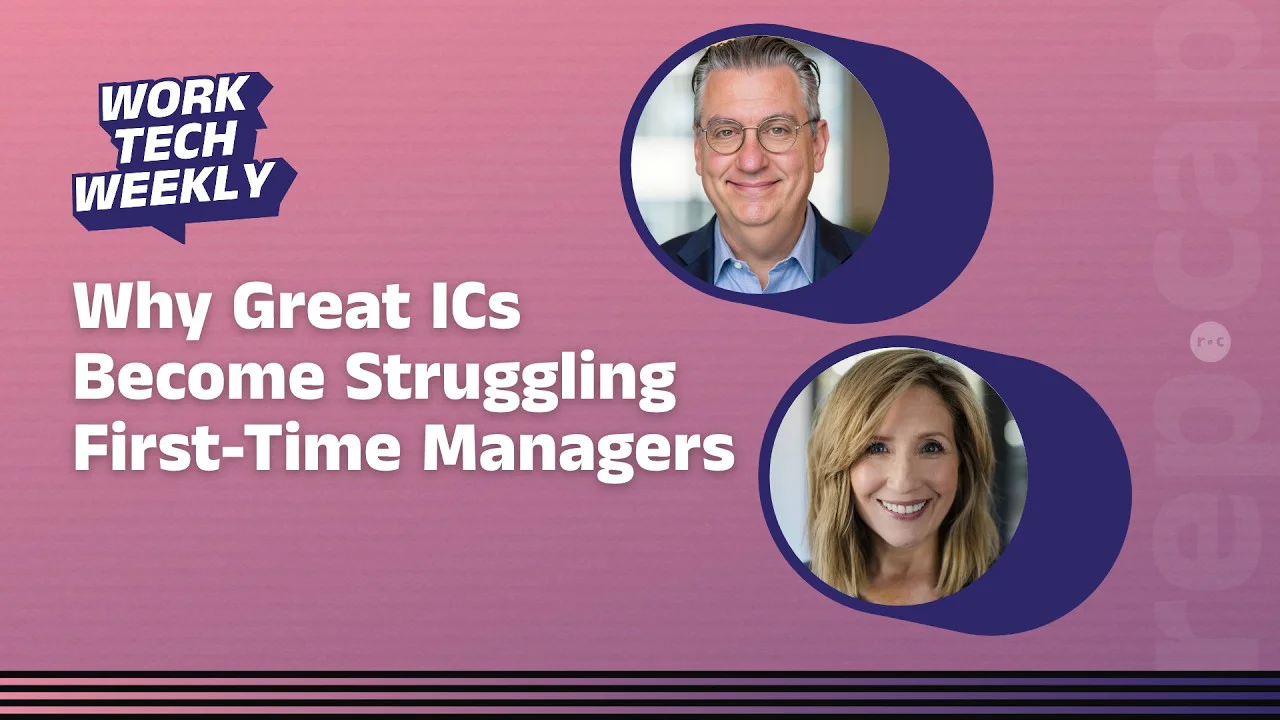
On Rep Cap's Work Tech Weekly, Rising Team founder and CEO Jennifer Dulski joins host Steve Smith to talk about why middle managers keep absorbing the cost of every reorg while getting about as much support as they did a decade ago. Jennifer explains how leading big teams at Yahoo and Facebook led her to start Rising Team, how Arti works as a personal trainer for every manager's leadership muscle, and why she believes the annual engagement survey, cohort training and self-paced video courses are on their way out. She makes the case for the super manager, someone leading 10 to 20 direct reports with AI handling the admin, and for judging L&D by retention and business results instead of course completions. She closes with a hopeful view: fewer people will have to become managers just to grow their careers, so the ones who do will be the ones who want it.
Managers were never given what they needed
The case against middle management rests on managers who never got real support. First-time managers get a title and a team and little else, and a one-day offsite fades within a week. Give every manager the kind of ongoing, personal development executives get, and they can prove their value.
Not every great IC should manage
Many strong individual contributors took a management job because it was the only way up. Jennifer expects fewer of them to have to: as companies flatten, talented ICs can keep growing as ICs, leaving a smaller, better equipped and more passionate group of managers. Knowing your natural talents, such as Rising Team's "cultivate", helps tell who will love the job.
A personal trainer for leadership
Arti does an intake with each manager, builds a growth plan for that person alone, and then supports it with coaching, voice-to-voice role play with an AI playing someone on their team, help with deliverables like performance reviews, and team sessions any manager can run without a facilitator. It doesn't take perfection, just intentionality.
The engagement survey is on borrowed time
Surveys run once or twice a year take months to analyze and arrive too late to act on. When managers bring real challenges to an AI coach, leaders see in real time what people are struggling with, and everyone who raised a challenge has already had help with it. Cohort training, relevant to maybe a third of the room, and self-paced video, with usage often under 10%, face the same pressure.
Measure outcomes, not usage
Jennifer says L&D tools have to prove business results, not count course completions. Rising Team measures test against control, manager effectiveness over time, engagement scores, and retention: a 33% increase for people who used it in the last month, and around 10% even a year later. It is starting to measure productivity gains too.
The rise of the super manager
With AI taking on administrative work (McKinsey puts it at around 18% of a manager's time), leading 10 to 20 direct reports becomes possible. That frees managers for Jennifer's three C's: clarify what good looks like, coach each person to their potential, and connect people into a team.
Jennifer: One of the things that's happening in this transition that we're in, in this market, is we'll have fewer managers. A lot of the people, especially in certain functions, were promoted to management just because they were good at their function. We won't need to do that as much anymore. Some of those people never wanted to be managers in the first place, but that was the only way to grow their career, and that's no longer true. So some of those really talented ICs will be able to stay and grow and do even more as an IC, which means we'll have a smaller and better equipped and more passionate group of managers.
Steve: Hey everyone, welcome back to another episode of Work Tech Weekly. I'm Steve Smith, managing director of growth at Rep Cap. Every round of cost cutting seems to land on the same people: middle managers. The ones who survive inherit bigger teams and get roughly the same level of support they got a decade ago, which is to say, not much. The idea that managers don't add value is wrong. We just never gave them what they needed to prove it.
My guest today is Jennifer Dulski, founder and CEO of Rising Team. Rising Team gives managers an AI leadership trainer that builds a personalized growth plan around each person and their team. Jennifer has spent more than 25 years in tech, including leadership roles at Yahoo and Facebook. She also teaches at Stanford's Graduate School of Business.
We talk about why the annual engagement survey is on borrowed time, and why training managers in a room together only ever worked for about a third of the room. We also get into the super manager: someone leading 10 to 20 direct reports with AI taking the administrative work off their plate. And we talk about why L&D has to start proving results instead of counting course completions. If you manage managers, or you sell to the people who do, this one is worth your time. Let's get into it. Jennifer, welcome to the podcast.
Jennifer: Thanks for having me. Great to be here.
Steve: It's great to have you here. We were talking in the green room: I talk to a lot of impressive people in this space, but your resume is right there at the top. You've had such an impressive career, and there's a lot that's very current in this moment to touch on. One thing I wanted to ask before we dive in: a lot has changed in our market over the past few years. Tech and talent and people is already a fast-moving arena, but it seems like it has really hit the accelerator. Is there a question you get asked now by CHROs or heads of people that you didn't expect to get asked even a couple of years ago?
Jennifer: You're really right about this. As you mentioned, I've spent a long time working in tech, more than 25 years now, and over that time I've seen a lot of things change. We literally went from the dawning of the internet to the development of streaming and messaging and mobile apps, and each time I think we thought, wow, this is the biggest change.
None of those come even close to what we're seeing with the advent of AI. It has turned everything upside down. It's completely changed the way everything works, and it's also a much faster change in terms of user adoption than any of those previous ones, because essentially anyone with a smartphone has access, which is everybody. So all of work has changed dramatically in the past three to five years, and that includes leadership development and all people-related content.
I think the main question I get asked is simply: how do I navigate this much change? It is a lot for people to handle, and a lot of it lands on middle and early-career managers who have very little training. It used to be, how do I support people to become a manager? That was already hard to do. Now it's, how do I support them to be a manager of people in an era where everything's changing so much more quickly, and people are really overwhelmed by that?
Steve: Absolutely. And bringing in some of your career: you teach at the Graduate School of Business at Stanford. You've spent time in the nonprofit sphere, worked at Yahoo, Change.org, Facebook. You were the first female entrepreneur to sell a startup to Google. It seems like one of the through lines of everything you've done is working with people at scale. Managers were a challenge for a lot of organizations even before this AI moment. When did you first realize it was specifically managers, and not just culture or engagement, where you needed to focus your efforts?
Jennifer: The interesting thing is that I don't come out of the people space, like a lot of folks who start companies like Rising Team. I was actually a division leader inside these big companies. I had teams of hundreds or sometimes thousands of people, and as an executive I got a lot of support, to your point. I had executive coaches. I was trained by incredible people. What was hard was taking that kind of high-touch support and scaling it out to my teams.
I remember, maybe 10 years ago, having so many managers come to me saying, "Help, I need help," and I didn't have the budget or the bandwidth to do anything that could really serve their needs. What I did at the time was hire an outside consultant, who was great. They came in and ran a big session for all the managers. We got them together at an offsite, and it was great for a day or two, and then they went back to their day jobs and didn't really take anything forward. I had spent a lot of money, and it just didn't feel sufficient.
That was the aha moment that caused me to start Rising Team: what if we could deliver high-touch, really personalized support at scale, in a way where managers not only get support on their own, but get the kind of help they can bring back to their teams? Because that's the key thing. Putting them in a room together really only solves half the problem. What you need is to give them the tools. I describe it like being taught to fish and then having to go back to the lake with a binder. What you need is the fishing pole. And so that was the genesis of Rising Team.
Steve: You've described Rising Team as the culmination of everything you've ever built, which, given your career, is a pretty bold claim. What does it mean in practice? What's actually possible now that maybe wasn't possible before?
Jennifer: It is incredible what's possible. We started Rising Team in 2020. I actually came up with the concept right before I knew there would be a global pandemic. The original set of products at Rising Team was synchronous, interactive team-building sessions: things managers could do on their own without having to hire a facilitator. That turned out to be very timely in a pandemic, because every team was separated and needed to do things that would make them feel connected.
But if you look back at the very first outline I wrote for Rising Team, there was a section called "personalized custom AI coach." My first startup was actually an AI company, back in 2009 and 2010. We built the models ourselves. I remember the whole team staying late, training the model. And then I led a pretty big AI team at Facebook. So I knew what was possible, and in 2020 it wasn't really possible to do what I was envisioning. But as the LLMs came out and became available, what I dreamed of not only became possible: it's now possible to do even more than I dreamed.
Our tool is called Arti, which is short for RT, Rising Team. It's a leadership personal trainer. It's essentially just what a fitness trainer does, but for your leadership muscle. It gets to know each person. It does an intake with them, finding out their challenges and their goals, and then builds a completely custom, personalized growth plan for each individual. So no longer do we have cohorts of managers sitting in a classroom, all learning the same thing at the same time. Every single person has a completely custom growth plan.
And it includes all the modes you might want. It has coaching, but it can also do voice-to-voice role play, so you can practice talking with another person. It plays someone on your team, because it gets to know your team. You can stop it in the middle and say things like "be more defensive" or "coach me on this." It will help you develop deliverables like performance reviews. And then it helps you with the team-building piece. It's so much more dramatic, the kind of support we can offer people, than we ever could with internal HR teams alone or with outside facilitators and coaches.
Steve: Another part of your pitch is that managers can run science-backed team development workshops without a facilitator. That sounds pretty great, but what's really hard about making that work?
Jennifer: It's funny, because we get a lot of questions about that, and sometimes pushback: "I don't think they're ready to do this. I don't think they can do it." And I 100% disagree. It is shocking to me how much anybody can do this if you just give them the right tools. We're a "just hit go" kind of platform. You pull up, let's say, appreciations. I hit go, everyone joins the session, and as I click next, they all see the same page, and all the activities are there. The timers are there.
Even if you do it badly. In the early days, we used to live-test every session before we released it, and we still do with new kits. I watched highly technical teams do these sessions exactly the opposite of how we hoped. They would keep their cameras off. They would read silently to themselves instead of out loud. At the end I would think, "Oh my god, they're going to hate this." And when they were asked for feedback, they said, "That was so great. We never have conversations like this. I can't wait to do it again."
So it doesn't take perfection. It just takes intentionality. That's all people care about at the end of the day. They want to feel seen. They want to feel understood. And if we take a tiny bit of time out of our day to do that, they will appreciate it, whether we're perfect or not.
Steve: Let's shift gears a bit and talk about the market. You've been through some cycles in Silicon Valley, and it seems like we're entering a bonkers era where everything we thought we knew has been blown up, and the level of not even vaporware, just outright snake oil, is off the charts. The L&D market broadly is huge, and it's absolutely full of stuff that doesn't work. When you look at the graveyard of failed management development programs, what does that look like from where you sit?
Jennifer: I think there are two pieces to this. One is the snake oil side you're talking about. There's always been snake oil; now it's a little easier to promote it and get it out to people, so you do have to be wary of that. Then, among the things that genuinely have worked in the past, I believe some are likely to see an end, because what we can do now is so much better.
One example, and I wouldn't have thought of this until I saw it, is the classic engagement survey. I'm sure you've taken these. Almost every company we talk to has an engagement survey. They run it once or twice a year. It takes them months to synthesize the data and get back the results. When they get it back, they're not sure how relevant it is anymore, because time has passed. They give the results to all the leaders and managers, and nobody knows how to act on them. This was me, inside these big companies.
I believe the engagement survey is about to die. When you give people tools like Arti, you get real-time data and insights about what people are working on, dealing with and challenged by, in the moment. When I look at the trend data that comes out of people using our tools, we can see the kinds of hard conversations people are practicing, and the themes: 40% of your company is saying they're struggling with the AI transition, 30% are still having trouble delivering performance feedback, some number of people say they're not getting clear direction from the top. Those things surface in real time, instead of a year later. And anyone who put in a challenge is already getting support, because they put it into their coach in the first place. I think we'll look back five years from now, maybe more, and say, "Do you remember when we did engagement surveys?"
A few other things I believe are changing a lot. The second is cohort-based manager development. There will always be some of it, just as there will always be human executive coaches. We're not trying to replace human executive coaches: there's a real place for them, there are so many talented coaches out there, and for executives who can afford them it makes sense. Cohort-based manager training may still happen, but it's honestly very expensive. It's either very expensive in person, or it's virtual and not very effective. We'll still bring managers together for building connections, but we won't have to train them in groups.
I compare it to training a group of 50 people to run a triathlon, which is sort of the equivalent of best-in-class leadership. If you put them all in a room, you'll have some people who are awesome swimmers, others who love to bike, and others who are runners, and you're teaching them all the same thing at the same time, which is relevant for maybe a third of them. So I believe that's also going away.
The other thing is self-paced video learning, where people do it on their own. That's been used as a way to offer something at scale, which most people then don't actually use. I think many of those products see something like sub-10% usage. For the 10% of active learners who really want that, those services are great. But companies won't have to offer it anymore, because if you can give a trainer to each person, it's much more effective.
Steve: What's your take on the current state of learning and development and the talent market? It seems like in just the past few years a lot of things have been blown up, and maybe that's not a bad thing, because so much of it was performative and wasn't really delivering value to managers or line-level employees, especially compared with what you're able to accomplish with Rising Team. Do you agree with that assessment?
Jennifer: When you say a lot of things have been blown up, what comes to mind for you?
Steve: The performance review, for one. Even learning and development plans, where there's no way to measure the benefit: all you're doing is notching course completions.
Jennifer: Yes.
Steve: Even with engagement surveys, there's a lot of "we're going to sculpt this survey so we get the answers we want, so we can show the board, so we can all get our bonuses," or not get fired, or a little of both.
Jennifer: Yes, that's all true. From the very beginning of founding Rising Team, I said one of the things we'd be rigorous about was measuring impact. Especially having been a division leader inside these companies, I would never want to buy a product where the only thing I could measure was whether people used it. So what if they use it? I need to know if I'm driving the impact I want. For most of their history, L&D products have measured their value in usage and course completion, maybe satisfaction too: people completed the course and gave it some kind of rating. We said we need to be able to do more than that.
Since the beginning, we've measured test versus control, and longitudinal movement in manager effectiveness scores. We measure against engagement surveys: I can look at your engagement survey and show you your scores with and without Rising Team, and by how many Rising Team sessions you do, and we see massive, statistically significant lifts there. We also measure employee retention over the long haul: not just whether people report a higher intent to stay, but whether they actually stay at their companies. We see a 33% increase in retention for people who have used Rising Team within the last month, and even after a year without using it, it's still driving something like a 10% increase in retention.
And we're just starting to measure productivity gains too. We can see things like customer success or IT teams actually resolving more issues when they use our product than when they don't. My belief is that any L&D tool of the future, whatever it looks like, will need to measure true business outcomes rather than just usage.
Steve: Here's a question about this moment in the market. We both work in the tech industry, and over the past two or three years there have been a lot of layoffs and a lot of cost cutting, and disproportionately the axe seems to fall on middle management. Management at that level gets a bad rap for not adding value, and you're building a product designed to help managers be more effective and improve team performance. When you look at that dynamic, what's your take? Is it just a phase, and if we provide better tools we can show that managers play a vital role? Or do you come to a different conclusion?
Jennifer: First of all, it's a tough market, and I want to be straight about that. Companies are cutting a lot of people and jobs all around, and it's a hard time to look for a job, so I want to acknowledge that reality. Part of it, I believe, is temporary. All organizations are working out how humans and AI will work together in the future, and many of the companies who let people go are hiring back, just into different kinds of roles. So I believe the job market on the whole will continue to grow. I know there are people who think we're all going to work a 20-hour week and machines will do the rest, and maybe that's true. I couldn't say.
What I believe is happening for managers specifically is this: the idea that managers provide no value is a fallacy. Look at the data that says 50% of people have quit a job because they didn't like their manager. On the other side, people will follow their manager from company to company. They'll go to the mat for a great manager. If you ask a crowd who's had a bad manager and who's had a great one, it's quite clear that really good managers are worth a lot inside companies, even purely for the task of taking the vision at the top and getting it out in a way people understand and incorporate into their daily work. You need some layer to do that.
What's happening now is that as you remove some layers of middle management, people are often getting bigger teams. And for the first time ever, I believe it's possible for managers to effectively manage larger teams. We call them super managers. I used to say no more than seven direct reports if you could avoid it. Now we work with a lot of companies where managers have 10, 20 or more direct reports, and before AI tools that would have been impossible to do well. Now it's actually possible, if you do it well.
A lot of the manual work managers do goes away because of AI. McKinsey says something like 18% of managers' time goes to purely administrative work, like writing reports to their own manager or very basic one-on-one tasks. If AI can take away a lot of that, and even some of the basic management work, or, to the degree managers are player-coaches, some of their player work, then it leaves more room for managers to do the front end and the back end: provide vision and clarity, help people understand what great looks like, set really clear expectations.
I call this the three C's of being a great manager: clarify, coach, connect. Clarify is: what does good look like? Coach is: how do I understand each person on my team, what they're great at, and how to help them reach their potential and grow? And connect is: how do I make this feel like a team? The more AI can take manual, administrative or IC-type work off your plate, the more time managers can spend on the three C's.
Steve: If the long-term vision is a world where every manager has the kind of development that used to be reserved for top executives, what does that change from a people standpoint? You've made the connection to the ROI story, connecting to business outcomes, and that's compelling. But what does it mean for the first-time manager who's still trying to find their way, or a mid-career professional trying to get to that next step in their career?
Jennifer: If you think about it, the vision of Rising Team is actually not about managers. It's about the workforce that works with the manager. We believe in a world where everyone in the workforce feels deeply understood, supported and empowered to reach their goals. That's what happens when you have truly great managers: you get an empowered and supported workforce. Then your business outcomes are so much better. People stay at your company because they're loyal to you and your mission, and your company is more successful. And the world's just better, because people feel understood. Wouldn't we all like to be understood?
As for the managers themselves, what I've always said about Rising Team is that I believe we can turn good managers into amazing ones by giving them the right support. I believe we can turn mediocre managers into really good managers. And I believe we can help poor managers either decide that they want to do it and become great managers, or decide that they're not meant to be a manager, which is OK.
One of the things that's happening in this transition is that we'll have fewer managers. A lot of people, especially in certain functions, were promoted to management just because they were good at their function, and we won't need to do that as much anymore. Some of those people never wanted to be managers in the first place, but that was the only way to grow their career, and that's no longer true. So some of those really talented ICs will be able to stay and grow and do even more as an IC, which means we'll have a smaller and better equipped and more passionate group of managers.
Steve: That gets to a question I was thinking about, which you've partially answered. There's almost a stereotype of the outstanding individual contributor who gets put into a management role and is just catastrophically terrible at it. Is it that the person never wanted to do it and should have stayed an IC? Or is it an amazing, talented person who just didn't have the right support, which maybe is now actually possible?
Jennifer: Yes, both are true. Two things happen here. One is that first-time managers get very little support. So even people who might be naturally good at it, with no support and no training, may not be at their best, because it's like the first time you do anything. I was probably a better parent to my second child than my first, although I watched the first one more like a hawk, so I don't know. All brand-new managers are under-supported, and now, with tools like Arti, there's really no excuse for that anymore, because it's incredibly affordable to support them in a way that's even better than what we could do before, and much cheaper.
The second thing is also true, because everybody has natural talents. We have an exercise in Rising Team where you take an assessment that helps you identify the things that really bring you joy and energy and come easily to you, versus the things you may be good at but that really drain you. Everybody gets a spider chart of their natural talents. There's a talent on there called "cultivate," which is the talent of loving to help people grow and develop, and bringing teams together. Anyone who has that, from any function, can be a great manager. If that one spikes all the way in for you, you're never going to love being a manager. You're just not, and that's OK. We really should try to put people in roles that align with their natural talents. They'll be happier and more successful, and so will the company.
Steve: Jennifer Dulski, this has been a fantastic conversation. Thanks so much for joining us and sharing a lot of very interesting perspectives with our audience.
Jennifer: Thanks so much for having me.
Steve: Manager development has been treated like an event for as long as I can remember. Get everyone offsite for a day or two, then send them back to their desks. By the following week, most of it is gone. The people who pay for that are first-time managers. A lot of them were great individual contributors who took the job because it was the only way up. They got a title and a team. Nobody gave them much else.
That model is gone; it just hasn't been replaced everywhere yet. The kind of support that used to be reserved for executives can now reach every manager, every day. And when AI handles the administrative work, managers get time back for the parts of the job that actually matter: being clear about what good looks like, and knowing each person well enough to help them grow.
There's a quieter shift going on here, too. Fewer people will need to become managers just to build a career. The ones who do will be the ones who want it. The case against middle management was built on managers who never got real support. Give them that support, and the case gets a lot harder to make.
If you enjoyed this episode, make sure to subscribe to Work Tech Weekly on Apple Podcasts, Spotify or YouTube. I'll see you next time.
Talk to our team about how you can drive measurable impact for your managers, teams, and business results.