Blood Cancer United's people leaders on why AI is a people change, why managers come first, and how a fully remote nonprofit built trust on a tight budget.


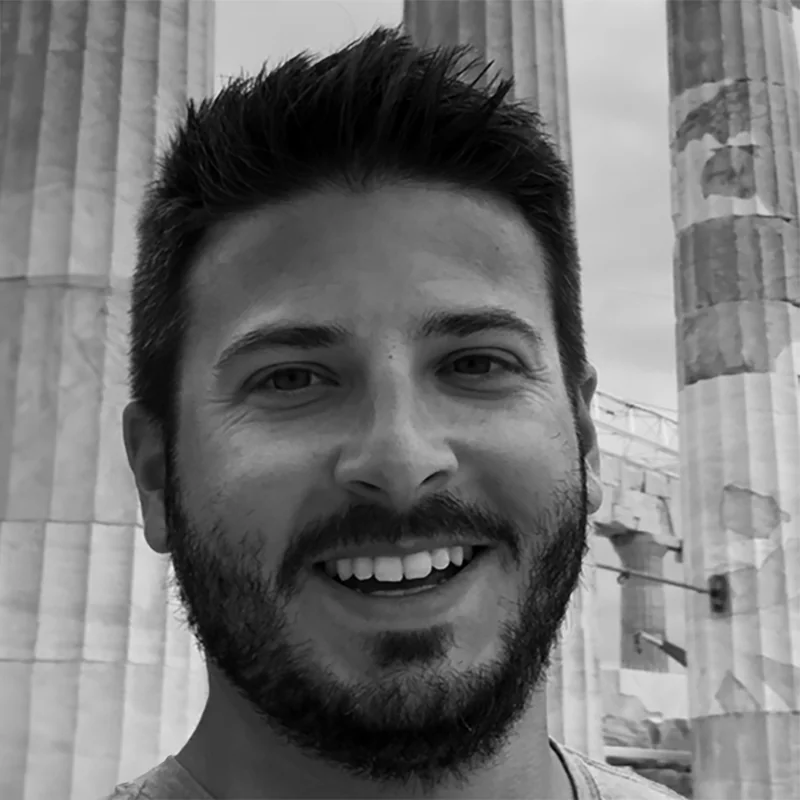
Orlando Ashworth, EVP and Chief People Officer, and Elisa Garn, SVP of Talent Management and Sustainability, are leading Blood Cancer United's AI transformation as a people change: managers first, trust as the foundation, and a simple, scalable way to develop every manager across a fully remote nonprofit.
“We used to get a lot in conflict resolution, requests to fix a problem. Now more of the requests are to enable growth… Instead of trying to solve, we're trying to create.” Elisa Garn, on what reaches HR now ▶ 40:27
Blood Cancer United ran into most of them. Here's what they did, and where in the conversation they talk about it.
Orlando's answer is to tell people plainly that AI is there to open the door to more meaningful work, and to set clear boundaries: what data goes into the systems, how bias is handled, how the output is used. “If I don't believe it'll be used the right way, I won't leverage it.”
Blood Cancer United leaned into managers first. Once they understand the what, the why and what's possible, it flows through goal-setting, performance management and incentives, so HR doesn't have to chase anyone to finish a course.
With expert facilitators and in-person programs out of reach, Elisa's team built a hybrid learning journey: homegrown resources, job shadowing and pilots to fail fast. For new tools the test was simple: easy to use, able to scale, and actually used.
Team sessions with the science built in give managers a reason to learn about each other rather than talk business. They run in meetings teams already have: the CEO ran one in an executive team meeting, and Orlando runs one in his monthly director meeting.
From seasoned leaders to first-time managers, Arti coaches each one with what it knows about their team. Elisa calls rolling it out “sneaking the veggies onto the pizza”: prompts built into development plans and career conversations, not a technology launch.
HR tends to wait and see. Elisa's challenge to her peers: if ownership hasn't been assigned, take it on, because two or three years of waiting means re-engineering everything later, and bringing people along all over again.
“Instead of trying to solve, we're trying to create.” What's different at Blood Cancer United since managers and teams started using Rising Team.
| Before | Now | |
|---|---|---|
| When a team needs a session | Find a consultant, if there's budget | The department's own leader runs a Rising Team kit ▶ 39:19 |
| What reaches HR | Requests to resolve conflict | Fewer requests, and they're about enabling growth ▶ 40:27 |
| Getting to know the team | One-on-ones, mostly about the work | Team sessions built to learn about each other ▶ 26:50 |
| Preparing for a hard conversation | Memory and instinct | Coaching from Arti, with the team's context ▶ 33:27 |
| Introducing AI | A technology initiative, announced | Prompts built into development plans and career conversations ▶ 33:27 |
Elisa needed a skip-level with an employee she rarely met. Would they prefer a formal conversation or an informal one? Should she bring an agenda? Her teams had been running Rising Team sessions together, so Arti, Rising Team's AI leadership personal trainer, had the context to help. She asked it how to approach the conversation, and which points would matter most to that person.
The conversation stayed on track and on what mattered to them. And that understanding doesn't live only in Elisa's memory: a new leader could get to know that person as quickly as it took her months to.
Afterwards, the employee told her it was some of the most valuable thirty minutes they'd had in a month.
▶ Hear Elisa tell it at 33:27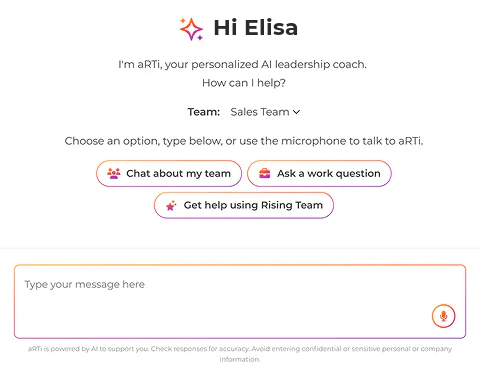
Orlando and Elisa's advice for people leaders: two to three years from now, the organizations that got AI right will be the ones that focused on people.
▶ Hear their advice at 44:46
As a people change, not a tech change, and without rushing it. Blood Cancer United started with basic training that meets everyone where they are, brought in the right tools (Copilot, Claude, ChatGPT), put governance around them, and communicated clearly how AI would help. People, not tools, drive how useful AI turns out to be.
Because the manager holds the biggest relationship with each employee. Equipping managers with the why and what's possible lets adoption cascade through performance management, goal-setting and incentives, instead of HR having to police compliance. The goal isn't to replace people with technology but to help them work more effectively with it.
Employees won't use tools they don't trust. Orlando Ashworth ties trust to enabling rather than replacing people, and to clear boundaries on data, bias and how outputs are used. Elisa Garn adds that trust is at an all-time low, and what people really want is to feel safe: clear expectations, honesty about the pitfalls, and the chance to build resilience.
A meaningful mission, growth opportunities, fair pay, stability, and above all a good manager. With CEO and board backing, Blood Cancer United gave managers a foundation in goal-setting, accountability and coaching, then added AI as a thinking partner, with the critical thinking staying human.
By treating it as a blank slate. Facing budget constraints and a 100% remote workforce, Blood Cancer United favored homegrown content, job shadowing and fail-fast pilots over expensive in-person facilitators, and chose tools on three non-negotiables: simplicity, scalability and adoption.
A few weeks, with an implementation specialist, and any pacing self-imposed to bring different groups along. CEO buy-in was decisive, and the sessions are simple enough to drop into an executive meeting, a monthly director meeting or a spare twenty minutes on the road.
The fastest route to human connection is vulnerability, and structured team sessions make space for it, in both directions. Their whole point is to learn about one another rather than to talk business, which is why Elisa Garn has learned more about her team through them than through most of her one-on-ones.
Teams that once would have hired a consultant now run a Rising Team kit led by their own department leader, and it has become part of the employee value proposition. HR gets fewer facilitation requests, and the ones that come in have moved from conflict resolution to enabling growth.
Orlando, maybe we can start with you, you're leading the AI transformation here at Blood Cancer United. How has it emerged over the past 18 to 24 months and landed at the top of your agenda? And how do you think about it as Chief People Officer, from both a tech and a people perspective?
It's a great question, and something we have to get right. This AI transformation is an imperative for people leaders and for organizations. At Blood Cancer United, we took a step back and said we want to do this the right way. A lot of organizations try to go through change too quickly, and if you don't bring leaders and people along, it doesn't work out in the long run. Our CEO prioritizes AI; we brought aboard a brand-new tech leader to help, along with our chief administrative officer, and our people team is heavily involved. What you hear in that is collaboration, because it's not just a tech change, it's a people change. We ask ourselves: how do we develop our people to be their best selves with the use of AI?
So we started with basic training, you can't skip the training process. We meet the lowest common denominator, because everyone isn't in the same place. Just level-setting people on what AI is and how to use it, bringing in the right programs, Copilot, Claude, ChatGPT, whatever you choose. Then putting the right structure around it through governance, and communicating it: here's how we're going to bring data and AI to Blood Cancer United, and here's how it will help you. We're still going through that evolution. But the bottom line is we don't want to rush it, we're treating it like a big change transformation, because it's here and we have to do it. It's not haphazard; it's purposeful. And under it all, it's people who really drive the usefulness of AI in the long run.
That's an exciting journey. Elisa, from your perspective, as you go through this AI transformation, how do you think about manager enablement and manager readiness?
It's a big one. As Orlando said, the people are what we're really asking to change; the technology is just a tool. We're primarily a fundraising organization, the majority of our employees are out raising money, asking people to donate to the cause we support. Think about the complexity of their world today, and then you add what some might call the burden of “now we also need you to learn new technology, reskill, and relearn ways you've done things.” Like any good change management, that comes with a healthy amount of friction and resistance.
So we've leaned into the manager group first, and “manager” can mean anything from people-manager leadership to self-management up to our executive team. Getting everybody to understand the why and what's possible is where we're at. “AI” is a fascinating term, because artificial intelligence is a very large bubble, if it's not your background, there's an expectation that it means a chatbot like ChatGPT or Claude. But AI has been around for decades; we're just at a pace of change that's bringing these tools to light. So we help educate: this is going to change the way we work. We have no interest in replacing people with technology, but we do want to empower our people to work more effectively with it and not fall behind the curve. I love working for a nonprofit that's this forward-thinking.
Going back to the manager part, managers have the biggest relationship with their employee. If we bring the manager along to understand the what, the why, and what's possible, that gets enabled through performance management, goal-setting, even incentives. So HR doesn't have to come in like the mother saying, “we need you to fill out your data-literacy training.” The manager understands it's better for their team's goals if their employees do it.
Both of you keep touching on the importance of the manager cohort. A recent McKinsey report found AI transformations are really driven on trust, the employee experience of AI isn't one message from the top, it's happening in their teams day to day. How important do you see trust becoming, for employees and managers, to enable all of this change?
Trust is extremely important. We look at the technology, how the organization is designed, the structure, the culture, our leaders, and when we bring it together, are we doing what's right for people? As an employee, when we talk AI, do I think it's here to replace me? So when a leader says, “no, we're not looking to replace you, we're looking to enable what you do, to open the door so you can do more meaningful work,” that's what success looks like. Trust is also about boundaries: how far do we go, what information goes into the systems, what does bias look like, how will it be used? If I don't believe it'll be used the right way, I won't leverage it. So trust is table stakes, the foundation of it all. And it's more than AI; trust doesn't start with AI. We've been here before. If my employees know we have their best interest at heart, and our donors and patients know it too, they'll lean into the change, because they know we're looking out for them.
Elisa, any thoughts on that?
Beautifully said. I think of trust in layers, as an employee, as a leader. We work in a time when trust is at an all-time low. Study after study shows people don't trust companies anymore, understandably, I have my own mistrust toward organizations selling my data. And the traditional relationship between employee and employer has shifted a lot in 20 years: pensions are basically gone, 401(k) matches are on the decline, and the incentives feel geared more toward a short-term transaction than a long-term commitment. Just like in personal relationships, if there's no long-term commitment, trust can only go so far.
So we have an opportunity in HR to tackle that, to understand what trust looks like today and get to the highest reasonable threshold as managers, leaders, and employees. People often ask for transparency and think they want all the information, but sometimes what they're really asking is, “help me feel safe.” That's a missed opportunity in organizations today. Helping people feel safe doesn't mean empty promises, or even promising job security, I don't think we can. It means: help me understand the expectations, help me understand the potential pitfalls, and give me the chance to build resilience so I can respond and move on if needed. AI is just one tool amid the whirlwind of everything else happening, but we feel we've built really good groundwork with our employees there.
AI is happening in the context of a lot of macro factors changing the employee experience. I'd love to hear about your journey around manager development. Take me back 12 to 18 months, what prompted you to realize this was an area you needed to invest in more?
I'll let Orlando take the bigger picture, this is a big deal for our CEO, Andy. Orlando, what did you hear from Andy that got this on the radar?
I like to keep things simple. Think about what makes a great workplace. First and foremost, it's a mission, something I want to show up for every day, something bigger than me. At a place like Blood Cancer United, check the box, we have that. Beyond that, it's growth opportunities, good compensation, stability, being able to take care of our families. But what makes it special is a good manager, a good leader. These are the building blocks of a great organization. So developing managers was a key component of what our employees needed.
How do we make sure managers have a good foundation, that they understand how to set goals, hold people accountable, coach and counsel along the way? That's what makes a really good manager. Once you have the manager piece set, you can use AI to help develop it. You use critical thinking, which is human-driven, not AI-driven, to ask the right questions: “coach me through how to have this discussion with my employee.” It helps you be a little better in your decision-making. Good managers are foundational to being an employer of choice and a great organization. Our CEO believes in that, our board believes in that, and it's just the right thing to do.
It sounds like there's broad recognition of that importance. Thinking about other tools, hiring a facilitator, executive coaching, rolling out training programs, what prompted you to consider a different approach at this moment?
To be candid, budget constraints. We're no different from other organizations trying to keep costs down and revenue up. Yes, we're a nonprofit, I worked for another nonprofit with a great tagline: “no money, no mission.” Going through a time where we had to trim really challenged us to get intentional about where we spend, and where we can get the maximum result for our people. That was a primary trigger. But as Orlando said, it's also the right thing to do. We don't want to fall so far behind that we become obsolete, behind on talent attraction, because who wants to work somewhere using outdated technology? Equally, people want to work for organizations that invest in their people, and we do that well even when times are tough.
It also presses us to be more creative. It's easy to bring in the experts, pay the fee, and check the box on a post-assessment. But because we don't have as many of those options, we've had to get creative, a hybrid learning journey with homegrown resources, job shadowing, and lots of pilots to try things out and fail fast. Innovation is really important to us, and HR is no different. There are tried-and-true practices, but there's a lot of opportunity for disruption in training, development, and manager upskilling, and with AI, it's ripe for doing things better and more collaboratively. One thing unique to us: we're a 100% remote workforce, which adds the challenge of keeping people connected to their managers. So it's almost like a blank slate, if we could do training, development, AI, and HR our way, how would we want to do it?, and then build a strategy around that. It's actually been really fun.
As you thought about the manager development space, what was important to you in bringing on a new solution?
We needed something that works well in a remote environment. In-person, instructor-led sessions are expensive and not very scalable. And it had to be simple. Orlando likes things simple, but don't we all? I don't want to click ten buttons to buy a widget on Amazon; make it easy and I'll give you my money. Work should be no exception. So we looked for simplicity of use, scalability, and adoption, because if people aren't using it and it's not having a business impact, it's a nice-to-have. Manager upskilling and team building are not nice-to-haves.
We needed something that meets our staff where they are, across a wide spectrum, from excellent, seasoned leaders to brand-new managers who've never done it before. We had a pretty long list of requirements, honestly, including implementation, support, and training. But I'm happy to say we found a great partner in Rising Team. We have some supplemental programs too, but I've been very pleasantly confirmed, not surprised, that all those needs have been met. Great partnership, great results, great comments. So it's, “okay, that gear's in motion, let's add the next gear.” Our momentum has reached a higher velocity because of it.
You have a fantastic team, and you need to scale to meet the needs across the organization. Can you speak to the implementation and getting everything started, what has that been like for your team?
I have a five-star team, and not just the team I manage; our whole HR team is phenomenal. Rising Team was one of the first things I brought to the organization; I'd been here just a few months, and I'd had experience with the platform previously, so we did a demo. I remember being a new leader and having my team in that demo. The feedback was, “this is really great, very impressive”, and then the cringe moment: “how hard is this going to be for us? We're already off track on other programs, we're down a resource.” What was so interesting is the follow-up call with the implementation team brought an audible sigh of relief, not only would we be supported by an implementation specialist, but the timeline wasn't the long, multi-step slog you expect from a technology rollout. It's as simple as you can be, but with depth. Implementation took a matter of a few weeks, and that was more on us, because we wanted to pace it and meet with different groups. You're trained, and then you're ready to go. Orlando is one of our biggest proponents.
He's constantly referencing it in meetings, “we should do a Rising Team as part of that.”
Yeah, absolutely. One key missing piece is that we wouldn't have done this without our CEO's support. Our CEO knew exactly what Rising Team was, we actually used it in an in-person executive leadership team meeting. If I can use it, it's easy. We pulled up one of the short fifteen-minute minis and knocked it out. I host a monthly director meeting and use it every month. Early on, when Elisa first joined, we were in Texas for a meeting with an extra 20 minutes, and I said, “let's do a Rising Team.” We pulled it up and knocked it out. You learn so much about your employees, you can develop skills, whatever you're looking for, it's right there. It's a great product.
How do you think about translating that team component to other managers, especially new managers who've never led a team session before? How important is the team-based experience in manager development?
Just about every research study says people don't work for companies, they work for managers. It's a little nuanced at Blood Cancer United, because people work for our mission, we have people willing to suffer for our mission, and we don't take that lightly or want to exploit it. So, going back to taking care of our people and building trust: if the manager-employee relationship is the most critical component of a staff member's success, it has to be top of mind. How do we establish trust, build the relationship, even just see another person when we're all so busy, when managers are going task to task, emails overflowing, barely making it to meetings on time? And how do we bring the team together as one cohesive unit with shared trust and shared interest in supporting each other toward shared goals? Nobody's ever figured that out 100%, people are complex; it's human psychology on steroids.
But having something simple, with the research and science behind it, that encourages you down a path of flowers instead of fighting through a jungle of thorns, is a huge enabler for managers. Right now I have two direct reports, the most I've ever had was 26, but my responsibility to each employee, to my team, and to myself is no less. If we can create opportunities to work in a confident state, where you feel good because, even if you don't see it in the moment, in retrospect you've sewn together the tapestry of that relationship just by doing the exercise, that's powerful. You can build it into your routines, schedule it, or have those pop-up moments Orlando mentioned. It all helps the manager be more successful, ultimately leading to business impact: better retention, better engagement, happier employees. I've learned more about my team through the mini kits than through most of my one-on-ones, because that's the whole point, we're not here to talk about business, we're here to learn about each other. I love it as an employee, as a manager, and as an HR professional with metrics attached to all of it.
I'll add to that. We said the fundamental of this transformation is trust. To gain trust, you do a couple of things: you say something and you do it, over and over, and you build human connection. The fastest way to human connection is through vulnerability. Some of the exercises in a program like Rising Team lead to spaces that allow us to be vulnerable. When our employees see that, they trust us; when we see it from them, we trust them. That's what we're after, and this is a tool that helps us get there faster.
Recently you introduced the AI leadership personal trainer. Some managers have led teams for 5, 10, 20 years; others are great individual contributors stepping into a new role; and the team context can be completely different. How important is that contextual, personalized experience, especially when you can't run ten programs for every manager?
It's been really big for us, even in the last six months, introducing our leadership philosophy and modules to set expectations: how do we measure performance, how do we operationalize our values? We've been implementing individual development plans, tools, and kits to support that. A lot of it is what a former colleague of mine used to call “sneaking the veggies onto the pizza.” Instead of announcing it, you're just having dinner, and you happen to be getting your vegetables. On the AI side, we sneak the veggies by saying, “here are some prompts you can use in Arti to build an individual development plan,” or “here's a prompt to start a conversation with your manager about your career options.” We combine that with career-pathing tools that leverage AI too.
It all comes together with the manager and team dynamic, helping the manager make more informed decisions with an individual or the team, and take a step back to think about the larger strategy. If my team is doing these kits and learning together, we capture those responses in a way that builds profiles for employees on the back end, not in a creepy way. I just read that Kroger keeps around sixty pages of data on each shopper and prices things based on your profile, and that's exactly how you destroy trust in a second, when people learn their data is being used in ways they weren't informed of.
So with Arti, as we capture information in this ongoing “help us understand who you are” way, the manager gets real leverage. For example, I recently needed a skip-level with an employee I don't meet with often. I wasn't sure whether they preferred a formal or informal style, or whether I should bring an agenda. Because we've done these team meetings and I had that context, I asked Arti for coaching on how to approach the conversation and what points would resonate most. It helped me have an incredible one-on-one, we stayed on track and talked about things relevant to them, and at the end they said it was some of the most valuable 30 minutes they'd had in a month.
I think I'm pretty intuitive at reading people, but having something that enables that means I don't have to rely on memory, and, heaven forbid something happened to me, a new leader wouldn't be at a disadvantage; they could understand that person as quickly and deeply as it took me months to. It's the integration of career development, manager relationship, and individual accountability, with AI surrounding all of it. The tools independently wouldn't be as effective if they didn't work together, including the people involved.
As you've rolled this out, what are you noticing that's different today than six or twelve months ago, any signals from managers or team members?
I'll let Orlando take that, since I know we're tracking it.
A couple of things stand out. First, I love word of mouth. Out in the field, talking to our executive directors and vice presidents, it's great to hear, “we were going to find a consultant, didn't have it in the budget, so we turned to Rising Team, found a great kit, went through it, and it was led by the leader of that department.” That put the leader in a great space, delivered the education and the session, and added value to the team. The feedback is, “what a great product, what a great benefit to Blood Cancer United.” That's part of our employee value proposition: come to Blood Cancer United, and you'll get good programs like Rising Team.
Serving the managers and teams, and hearing they're having a great experience, is what matters. Elisa, anything you or your team hears?
We do a lot of facilitation, and we're getting fewer requests, I think because people are starting to use the technology and the options available to them. Teach a person to fish. I don't have the utilization stats in front of me, but anecdotally, the requests we do get are different. We used to get a lot in conflict resolution, requests to fix a problem. Now more of the requests are to enable growth. That's a really good signal of how the organization is shifting: instead of trying to solve, we're trying to create.
We'll have other cycles, any organization that grows has periods of struggle. I use the analogy of lobsters: their DNA doesn't deteriorate like ours, so they grow their whole lives, but to grow they have to shed their shell, push through a period of discomfort and vulnerability before the new shell hardens. The signals I'm seeing point much more toward growth conversations. And it's exciting, because when you've been on the conflict side for a while, it wears on you. We can still address problems when they arise, but the general direction is a really positive place. Our biggest competitor is cancer, and I don't know anyone who'd side with cancer. We do what we do so our employees can serve patients and caregivers with blood cancer, that's the end all of what we're doing.
One last question for both of you: over the next two to three years, for organizations investing in AI and leadership and people development versus those focused solely on the tech side, where does that put organizations, and what does the difference actually look like?
If we look back two or three years from now, I think we'll find that the organizations that got it right focused on people. That's why I believe we're taking the right steps at Blood Cancer United, we've made this whole AI transformation human-centered. It's about the people who get the work done, who connect with our patients and caregivers. AI is the tool that enhances our innovation and helps us at the fundamental things; it frees up our minds to think about the bigger picture. But at the end of the day, it's about us, about you, about me, about our employees. AI is just a tool to help get us where we're going faster.
The only thing I'd add, and I'll speak to my HR friends here, is that our profession tends to be risk-averse by nature; it's a core part of our job to protect our organizations. Because of that, we often default to “wait and see.” There's been a lot of debate about who should own this, CTO, CIO, CPO. Frankly, if it's not assigned, raise your hand and take it on, because it needs dedicated attention now. If you're two or three years down the road and still waiting to see, you're not just behind, think of how much time has passed that you'll have to go back and re-engineer, plus the change management of bringing people along.
We've doubled down on this: we're committed, with a full plan, people first. Maybe other organizations aren't there, but at least making progress, and setting infrastructure to support down the road, would be not just wise but imperative. The pace of change isn't slowing; if anything it's speeding up. Two to three years from now is the equivalent of going from 1970 to 1990. Whether you're for-profit or nonprofit, this is the way the world is shaping. Being a champion of that change, rather than resisting it or waiting for it to happen to you, is an amazing opportunity to elevate our profession, and, more importantly, to steward human-centric design within our organizations, which is where we should be focused all along.
That's what matters. Elisa and Orlando, thank you so much. I'm really inspired by this conversation, what you're doing in service of the mission and in empowering your people. We're so proud to be partners and to help support your mission at Blood Cancer United.
Thanks, Ryan.
Thank you.
See how Arti and Rising Team's team sessions would help the managers in your organization lead their people through AI.