Whether you’re a first time facilitator or a trained expert, Rising Team
makes it easy to lead a team session like a pro. Just follow the steps in
each kit and it's plug-and-play, from icebreakers to ground rules to
discussion prompts. This guide walks through the process for anyone
facilitating their first Rising Team session.
(And if you’re an
expert facilitator, then feel free to use what’s helpful and adapt as you
wish!)
Whether you’re a first time facilitator or a trained expert, Rising Team
makes it easy to lead a team session like a pro. Just follow the steps in
each kit and it's plug-and-play, from icebreakers to ground rules to
discussion prompts. This guide walks through the process for anyone
facilitating their first Rising Team session.
(And if you’re an
expert facilitator, then feel free to use what’s helpful and adapt as you
wish!)


Log in to app.risingteam.com,
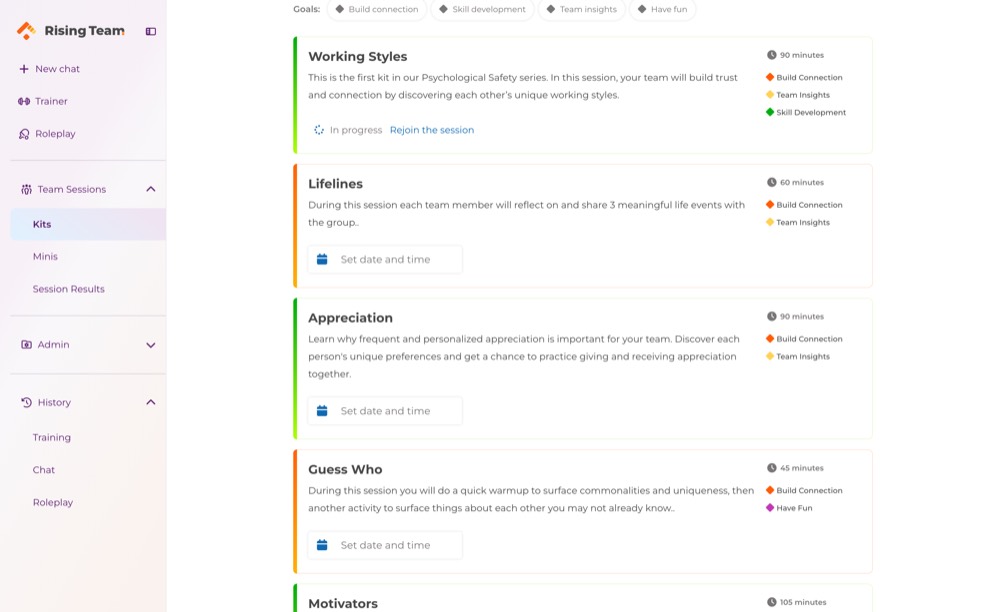
open Team Sessions › Kits, and choose the session you
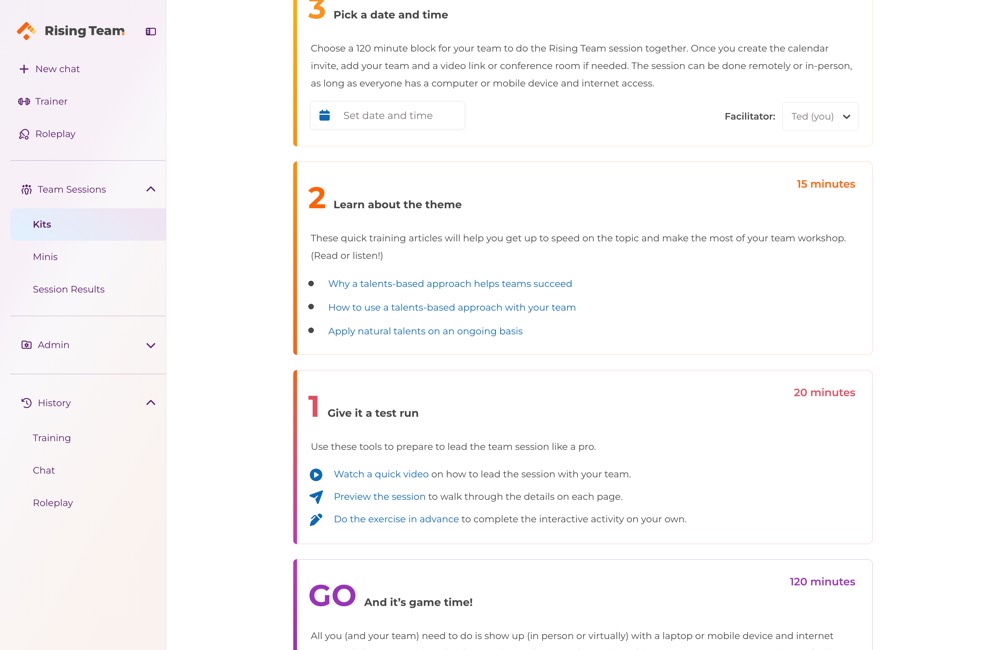
want to run. Each kit page is laid out as 3, 2, 1, GO;
step 3 is “Pick a date and time.” Set the date, then add it to your
calendar. Keep in mind—Rising Team does not send calendar invites to
participants. Be sure to add your team members and include a video link or
conference room in the invite.
Every kit tells you how long it
needs, and it varies: Connection Kits are typically 60 minutes, and
Development Kits run 90 to 120. Book a block that matches the kit you
picked rather than a fixed two hours.
Invite anyone whose working relationship with you matters—direct reports, cross-functional partners, and “dotted line” reports. A session holds a maximum of 14 participants, and the session screen shows the cap as people join. If your group is larger than that, Minis are built to scale and run comfortably with up to 40 people. And if you need to run a full kit with a bigger team, email hello@risingteam.com—we'll help you find the right shape for your group rather than leaving you to improvise it.
Our general recommendation is that managers or team leads facilitate the Rising Team sessions so they get a chance to learn and actively practice key leadership skills with their team. That said, anyone can facilitate a Rising Team session—it doesn't always have to be a manager. Teams can rotate this role to different people on the team, or even to someone outside your team like an HR or Ops partner. There is a dropdown to change the facilitator on the kit landing page for each kit and within the session itself.
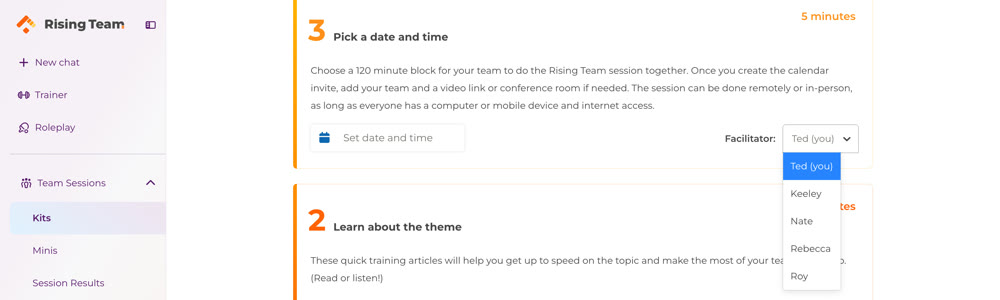
Steps 2 and 1 on the kit page are your prep, so you are not going in
blind. Learn about the theme (about 15 minutes) gives you
short training articles you can read or listen to.
Give it a test run (about 20 minutes) lets you watch a
video of the session, preview it page by page, or do the exercise yourself
first.
Budget around half an hour in total. If you are short on
time, the “Watch a quick video” link is the one to keep—and you can watch
it at 1.5x or 2x speed. Connection Kits ask for much less, a single
10-minute prep step, and Minis need no prep at all.
If you
would like to share something about the kit with your team beforehand, the
first training article is a good option; hit the “Share” button at the top
of it for a shareable URL.
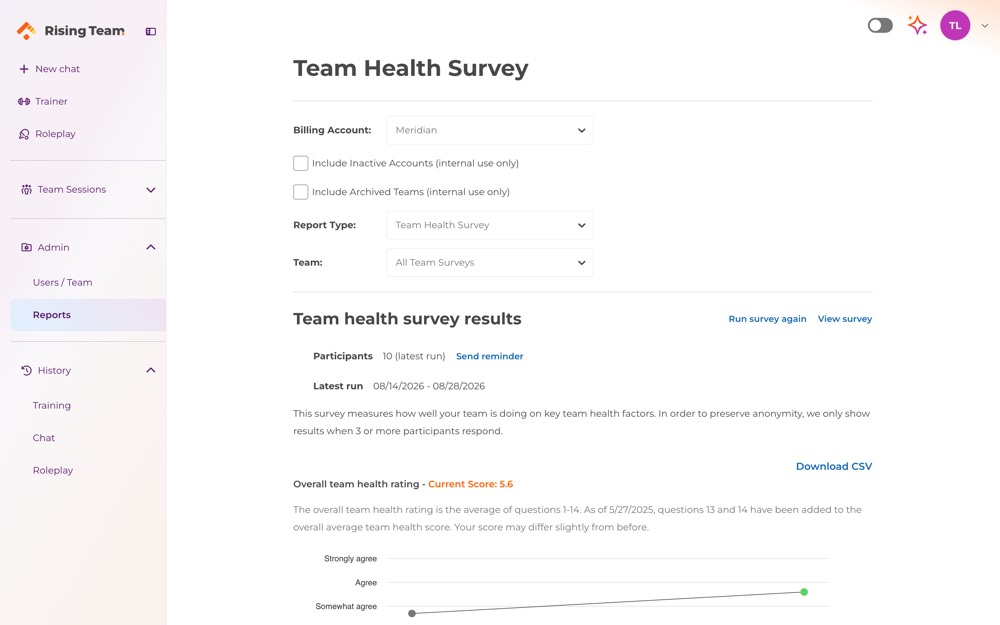
Before your first session, consider running the
Team Health Survey. It is 14 questions and takes your
team a few minutes. Run one early to set a baseline, then re-run it
periodically to see how things are trending.
You will find it
under Admin › Reports. From there you can run a survey,
view it, and send reminders. To protect anonymity, results only appear
once three or more people have responded, so leave enough runway before
your session to send at least one reminder.
When the day arrives, open the kit and click the orange
Start Session button in the GO section (or use the link
in the calendar invite you set up through Rising Team). You will be given
a session URL and code to share with your team over email or chat, plus a
QR code they can scan. You don't need to invite people ahead of time;
they just need the code to join. The code expires after five
hours.
If someone joins a session late, they can still
catch up by using the same URL and code, clicking next until they reach
the page the rest of the team is on.
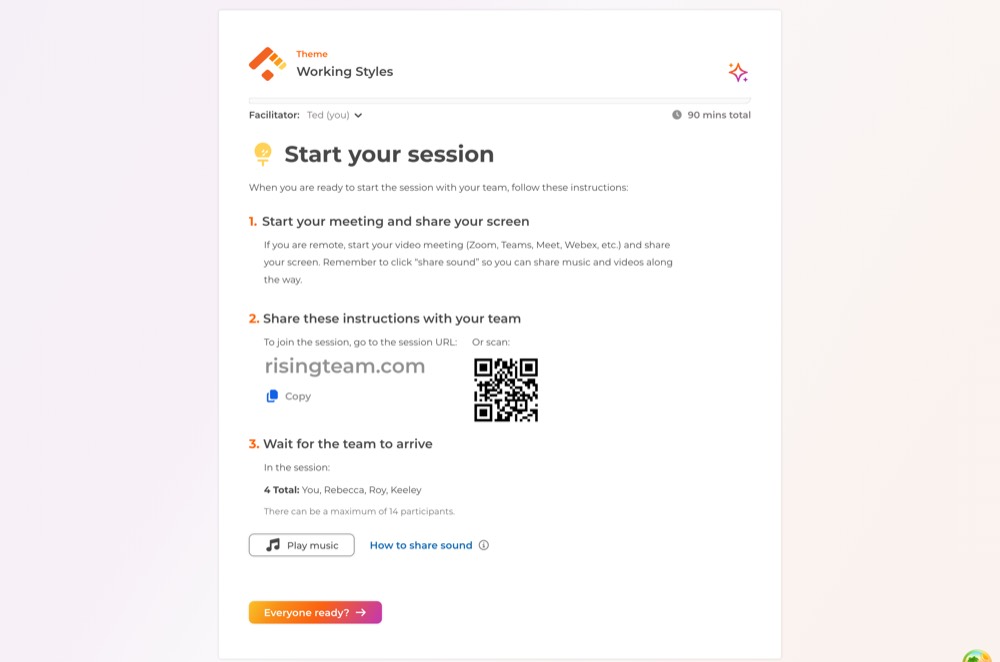
Allow time for everyone to get set up on a computer or mobile device.
Everyone needs to be on a device so they can complete the interactive
exercises, whether they are in-person or remote. If you are running the
session virtually, start your video meeting (using Zoom, Teams or whatever
your company uses) and share your screen.
Look for the gray
Facilitator tips boxes beside the content throughout the
session. They only appear on the facilitator's screen, and they tell
you when to share your screen and when to stop.
You'll
find an on-theme song to play while you are waiting for people to join.
Click the “How to share sound” link near the bottom of the page for help
setting up your audio.
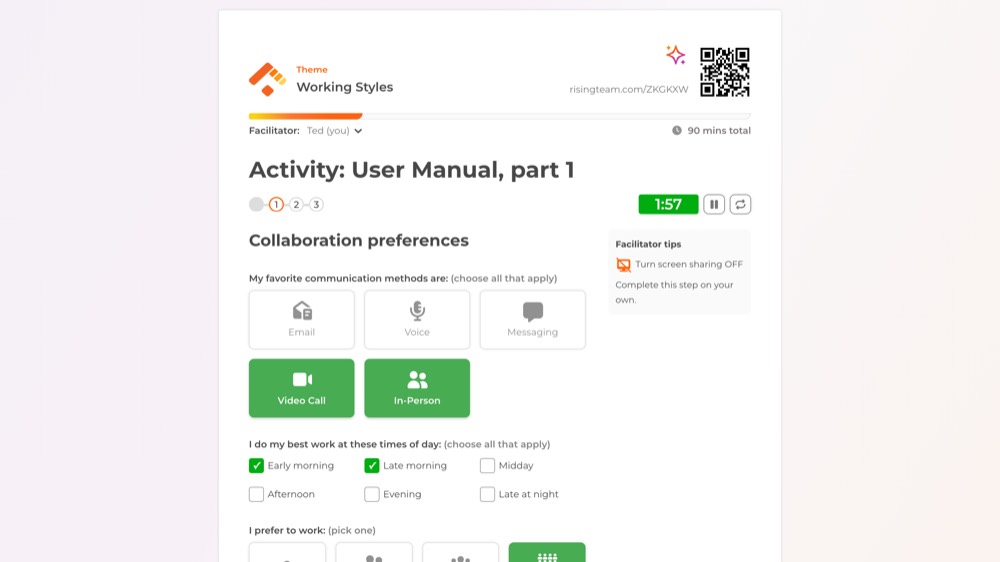
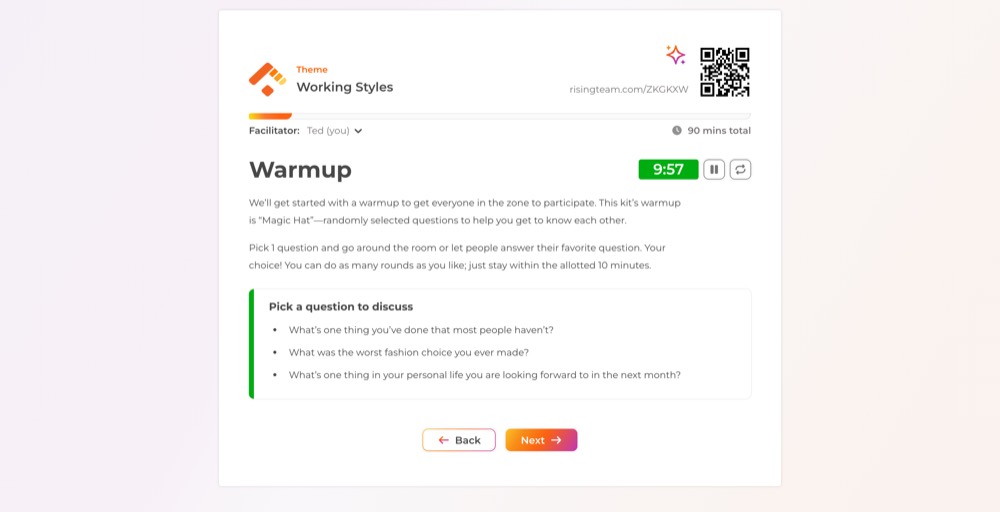
Follow the prompts on screen all the way through to the end, and ask your team to click their own orange “Next” buttons so everyone stays on the same page as you. Don't forget to participate in the exercises yourself! (You can also do them ahead of time in the “Give it a test run” section on the kit page.)
Screens with an interactive exercise carry a countdown timer, and you can
pause or reset it at any point. The timers are only a suggestion; spend as
much or as little time on a screen as you see fit. If one step elicits a
deeper conversation, let it run and shorten a later section to make up the
time.
The header shows the kit's total length and a
progress bar for the session as a whole, so you can read your pace at a
glance and adjust what is left.
There is a brief survey at the end of each session that will give you a sense of what your team thought. If you are running out of time, we suggest you skip the reflections section and jump straight to the survey to make sure you get this feedback.
Some steps will have suggested discussion prompts; if those aren't
sparking a good conversation, ask your own questions. No matter how you
improvise, the kit structure ensures it will be a good experience for your
team.
People on your team will take their cues from your own attitude towards
this new experience. If you're excited, they'll be excited.
It's easy to feel rushed or cynical, but projecting this will make it
harder for people to open up. Some may arrive at the session with a sense
of skepticism. Exude a sense that it's worth your time (which it is!)
and that you are eager to learn, connect, and participate with an open
mind.
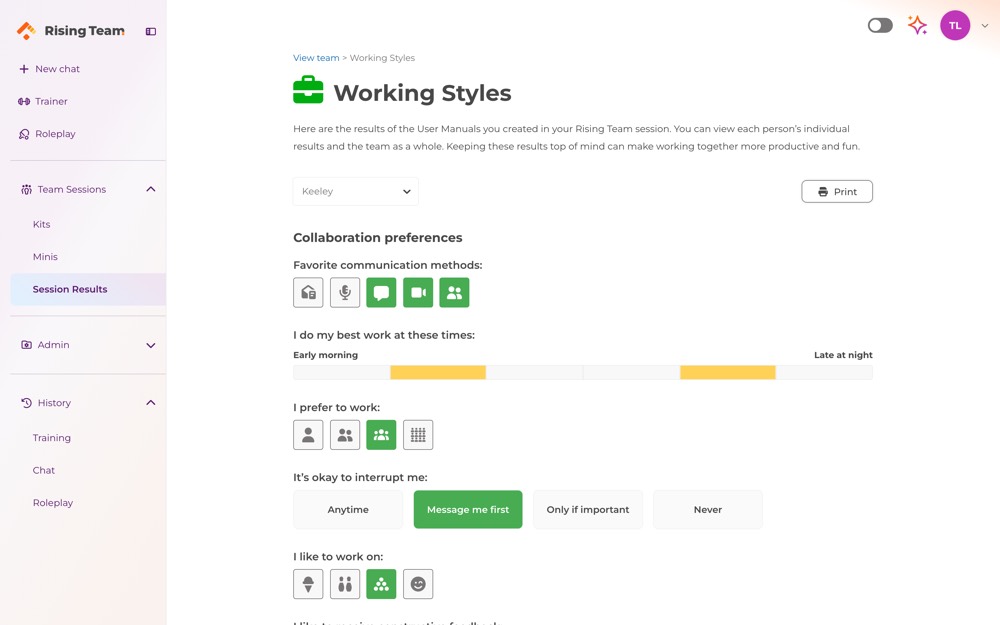
Each kit involves a team exercise related to the kit theme. After the
session is over, you can see individual results as well as a consolidated
view of the full team anytime via
Team Sessions › Session Results. Open any person and you
will see how they prefer to communicate, when they do their best work, how
they like to receive feedback, and what they would like their teammates to
understand about them.
Revisit these periodically and consider
using them as a reference when talking with team members one-on-one. Any
results page can also be printed.
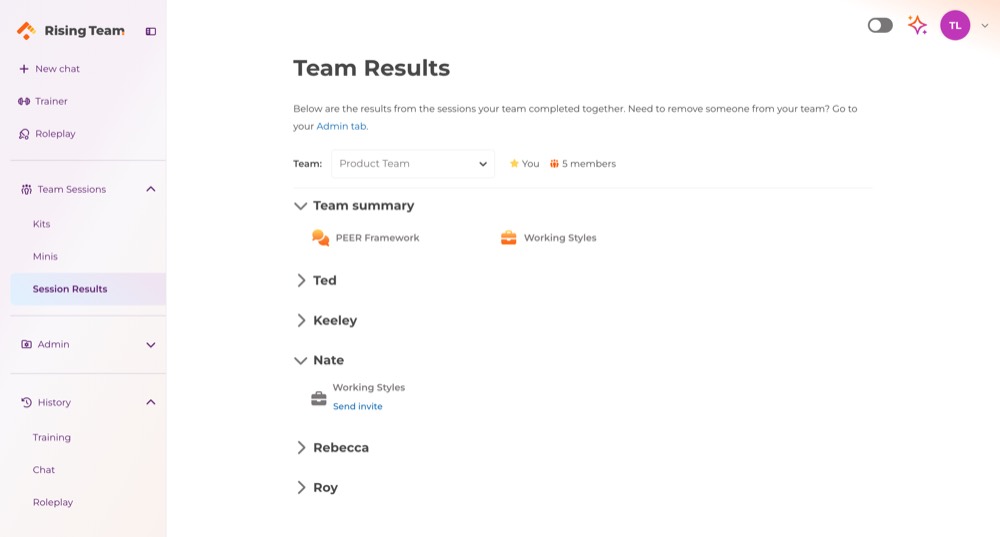
If a person missed the session entirely, or joined your team afterwards,
open Session Results, click their name, and use
Send invite next to the exercise they are missing. They
can complete it in their own time and it joins the rest of the team's
results.
Someone brand new to Rising Team has to be added to
the team first, which an account admin does under
Admin › Users / Team.
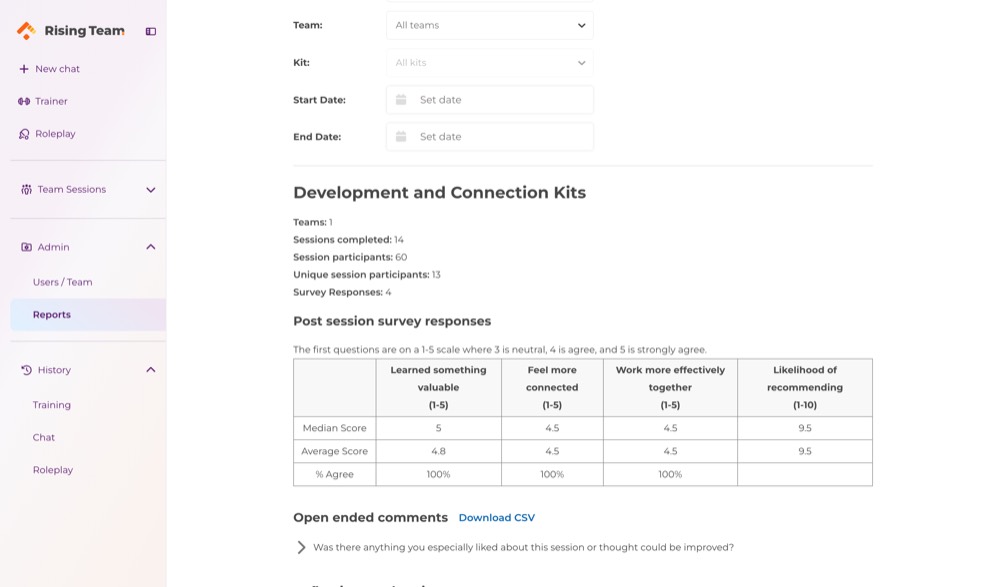
Admin › Reports offers a Kit Summary report that combines the end-of-session survey results, exercise results, and reflections and action items by team for each kit. Since this page is also viewable by company admins, the results are anonymized to keep what people share confidential to the team that completed the session together. After your session is completed, we'll also email you a link to this report.
After a Development Kit, we email you a Leader Action
once a week for six weeks—one small, concrete practice at a time, each
with a link to mark it done, snooze it, or skip it. On some kits your team
members get their own actions too, so the whole team is practicing rather
than just you. Connection Kits and Minis don't send
them.
Arti can pick up where the session left off.
Once a kit surfaces something—a teammate who wants feedback delivered
differently, a working style that clashes with yours—you can talk it
through with Arti, our AI coach, and come away with a plan or a script. If
the next step is a conversation you're dreading, Roleplay lets you
practice it first and get feedback before you have it for real. Both sit
at the top of the left-hand navigation—Roleplay under its own name, Arti
behind New chat—if your account has them switched
on.
It's also worth re-reading the last training article
from “Learn about the theme,” which carries tips for building on what you
covered, and raising the session in your 1-on-1s.
You can update your own exercise results at any time from your results
page in Session Results. It's worth asking your team
to do the same from time to time, as attitudes and preferences do
change.
Some results pages—your Talent Profile among them—also
offer a Share button that generates a unique link anyone
can view. Share appears only when you are looking at your own results, and
it is not available on every exercise type.
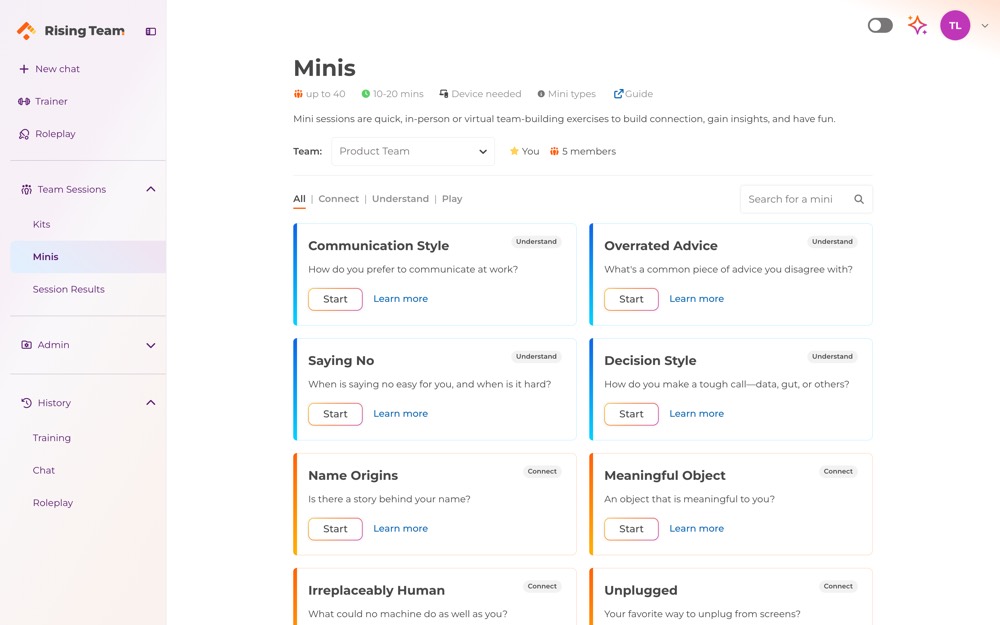
Alongside the full kits, Minis are 10 to 20 minute
exercises you can drop into a regular meeting, sorted into Connect,
Understand and Play, and they run with up to 40 people. They ask far less
of everyone's calendar and lean on team bonding rather than
skill-building.
Alternating Minis with the longer kits is the
easiest way to hold a rhythm. We recommend doing one or the other about
every six weeks.
We're easy to reach, and we're here to help! Email us any
questions at
hello@risingteam.com or join
the Huddle, our private Slack community that's built for managers using Rising
Team.